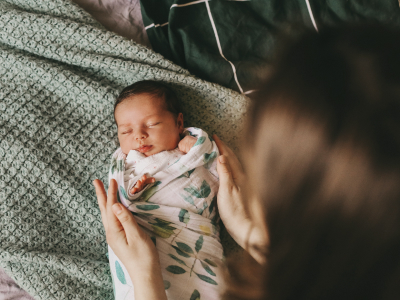
Newborn babies benefit from lying skin to skin with their mothers as soon as possible after birth. Benefits of skin-to-skin contact include bonding, stabilizing baby’s heart rate and breathing, and providing warmth for the baby.
- Your baby will begin to root and search for the breast within the first hour. If you plan to breastfeed, a nurse can help you get your baby latched and positioned properly.
- The first one or two hours of bonding is called the Golden Hour, and we encourage you to spend this time with your baby and birthing partner only.
- Other family and visitors should be invited to see you and the baby after your initial bonding and breastfeeding time has ended.
- Nurses will monitor the health of mom and baby during this time. Your nurse will review proper perineum or cesarean incision care with you.
- Plan to stay in the hospital with your baby for two to three nights.
- While in the hospital, you will be given paperwork to complete the birth certificate. You’ll receive a temporary copy when you go home.
- Several tests will be given to your baby, including Phenylketonuria (PKU) screening and a hearing screening.
- If you have questions or concerns during your hospital stay, speak to your nurses. They want to keep you comfortable and help you learn about caring for your baby so you’re confident when you and your baby go home.
Baby’s Safety & Security
Willis Knighton security policies ensure the safety of newborns.
- Look for a Willis Knighton picture badge to easily identify anyone authorized to provide care for you or your baby.
- Do not give your baby to anyone without checking for proper identification. Immediately contact nursing staff if a situation is uncomfortable for you or if you have concerns.
- Babies are always transported in rolling, open cribs. Only properly identified staff may transport your baby. Neither the mother nor family members should remove the infant from the room.
- Never leave your baby alone or unsupervised in the room.
- Don’t sleep with your baby in your bed. This is dangerous and can result in falls and or suffocation.
- Do not remove the identification bracelets for mother or baby while at the hospital. These bracelets are critical for identification and care.
- A security sensor attached to your baby’s ankle links to our infant security system. If anyone tampers with or removes the band or takes your baby out of the authorized area, the infant security system alerts staff. Staff members are trained to respond to prevent your baby from leaving the area.
- Be sure you have installed an age-appropriate car seat in the car before the day of discharge. Babies cannot be released from the hospital until we verify that the infant car seat is installed.
Visitor Information
Every delivery is special. Please remember that new mothers need time to recover from labor and bond with their babies. Here are tips to help you be a supportive visitor:
- Wait several hours after the birth before you visit. This will give mother and baby time to bond.
- Siblings 3 to 12 years old with shot records may visit. Any other visitor must be over the age of 12.
- No more than two people should visit at a time.
- Don’t take food or coffee into patient rooms because smells may make the mother feel queasy.
- Rest is critical for patients. Please limit light and noise in rooms or waiting areas. This includes loud conversations.
- Please show respect for each patient’s privacy and wishes.
Sibling Visitation
Siblings are the only children permitted to visit the Nest, and they should arrive at least two hours after the birth and mom’s recovery. Because newborns are at risk from germs, help us assure that a sibling visit will not expose the newborn to infections. Here are some things to consider before planning a sibling visit:
- A current immunization record is required for each child who visits.
- A nurse will check for written proof that the varicella (chicken pox) vaccine has been administered to a sibling visitor at least six weeks prior to the hospital visit.
- A nurse will take the sibling’s temperature and have the child wash his or her hands before visiting the newborn.
Siblings who have had any of the following symptoms in the past two weeks should not visit their mother and the newborn:
- Fever
- Runny nose, cold, or any respiratory infection
- Cough
- Diarrhea or vomiting
- Rash
- Draining sore
Siblings who have been exposed to the following diseases within the past three weeks should not visit their mother and the newborn:
- Chickenpox
- Mumps
- Measles
- Rubella
- Diagnosed illness